On this page
Three ways to turn crypto into pula
No exchange pays pula straight into a Botswana bank, and none holds a pula balance for you. Selling therefore means one of three routes: a P2P buyer pays your bank account, a P2P buyer pays your Orange Money wallet, or you sell for dollars on an exchange and withdraw to your Visa or Mastercard.
P14.71
Best P2P price for 1 USDT, Binance
Snapshot, late Nov 2026
P14.06
Best P2P price for 1 USDT, OKX
Same morning
≈P14.33
Mid-market dollar rate for comparison
ExchangeRate-API
Bitcoin needs one extra step. Binance had no pula ads for BTC on the snapshot day, so you would swap BTC for USDT on the spot market first (Binance charges a regular user 0.10%) and then sell the USDT. On a card exchange you sell the bitcoin for dollars and withdraw those.
Which route suits you depends on the amount and the urgency. For a few hundred pula you want as cash, Orange Money is the simplest. For larger sums, have the buyer pay your bank, because wallet limits start to bite at P10,000. If your coins already sit on a card exchange and you would rather not deal with a stranger, withdraw to a debit card: a Mastercard is quicker but capped at US$2,500 (about P35,800) a day, while Visa allows up to US$50,000 a day but can take two days.
Sell USDT on P2P to your bank or Orange Money
On P2P you are the seller. Your USDT sits in escrow while the buyer pays you, and it leaves your control only when you release it. In our 23 Nov 2026 check the best Binance bids were P14.71, P14.70, P14.69 and P14.67; OKX’s best was P14.06, but it had 62 buyers against Binance’s 12.
Sell USDT for pula on Binance or OKX
-
Move USDT into the P2P wallet
If your USDT sits elsewhere, send it on a network both sides support. CEX.IO, for example, charges 1 USDT to withdraw on BNB Chain, Solana, Polygon or TON and 3 USDT on Ethereum or Tron, with a 10 USDT minimum.
-
Compare the bids
Choose Sell, USDT and BWP, filter by Orange Money or bank, and read each buyer’s price and order limits.
-
Add your payment details
Add a bank account or Orange Money number in your own name. It should match the name on your verified exchange account.
-
Check the money, then release
When the buyer marks the order paid, open your banking app or dial *145# and look at the balance. Check that the payer’s name matches the buyer’s. Release only when the full amount is there.
Bank or Orange Money?
Orange Money is quicker to check and accepted by almost every buyer (61 of OKX’s 62 buy ads), but it has limits. Orange lists P10,000 per transaction, P15,000 a day and a P50,000 balance, and taking cash out at an agent costs P6–P114. A bank account has no wallet cap, though a transfer from a buyer at another bank waits for a clearing window. For sales above about P10,000, ask for bank payment. The P2P guide explains merchant ratings and disputes.
Binance or OKX for selling?
Binance paid more on the snapshot day: P14.71 against P14.06, a difference of P0.65 on every USDT. OKX had five times as many buyers, and some of its merchants accepted orders above P1 million, which matters when the best Binance buyer’s limit is smaller than your sale. For a large amount, splitting it between two or three Binance buyers at P14.67–P14.71 usually still beats one OKX order, but check each buyer’s limits and completion rate first.
Withdraw to your Visa card
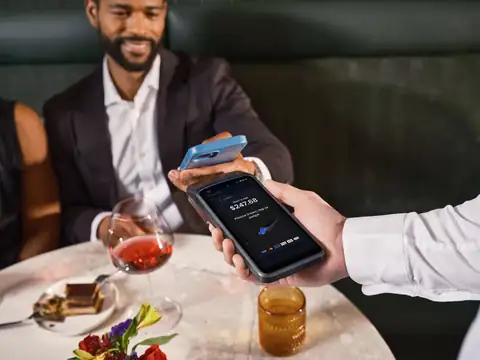
The second route skips the stranger. CEX.IO lets Botswana users withdraw to a Visa or Mastercard: Botswana is not on either of its card withdrawal block lists. Visa withdrawals take up to 48 hours, with US$20–US$50,000 a day; Mastercard withdrawals take up to an hour, with US$20–US$2,500 a day. Ten successful withdrawals are allowed per day.
The fee is the same 0.49%–4.99% plus a service charge as for card deposits, and your bank decides the rate at which the dollars become pula. Google Pay and Apple Pay cannot receive withdrawals, and CEX.IO says withdrawals to prepaid cards mostly fail, so use a bank debit card. CEX.IO holds no NBFIRA licence; it is licensed and registered abroad (US FinCEN MSB, NMLS 1804170; UK FCA FRN 1007192).
Cash out to your own debit card
Our #1 pick pays withdrawals to Botswana debit cards: up to 48 hours for Visa, up to an hour for Mastercard. Check the fee and service charge on the withdrawal screen first.
Bitcoin ATMs in Botswana
Botswana’s first bitcoin ATM was installed in Gaborone in March 2019 by Express Minds, now one of the eight firms on NBFIRA’s virtual-asset register. Reports at the time described a Lamassu machine at a Gaborone mall that only sold bitcoin, with a limit reported as about US$5,000 a day. It never bought bitcoin, so it could not have cashed you out.
The only listing we could find was on CoinATMRadar, which blocked our check; a user comment there from October 2023 said the machine was not working. As of November 2026 there is no confirmed working bitcoin ATM in Botswana. Treat anyone offering an “ATM cash-out” on WhatsApp as a likely scam.
Fees and timings compared
| Route | Main cost | Timing | Limit to watch |
|---|---|---|---|
| P2P, paid to your bank | The buyer’s price (best P14.71) | Next clearing window, then up to 60 min | Buyer’s order limits |
| P2P, paid to Orange Money | Same price, plus P6–P114 to cash out | No bank clearing | P10,000 per transaction |
| Card withdrawal, Visa | 0.49%–4.99% + service charge | Up to 48 hours | US$50,000 a day |
| Card withdrawal, Mastercard | 0.49%–4.99% + service charge | Up to 1 hour | US$2,500 a day |
| Bitcoin ATM | None confirmed working | — | — |
A worked example shows how much the price matters. 500 USDT sold at P14.71 brings P7,355; at P14.06 it brings P7,030, which is P325 less. At the mid-market rate of about P14.33 the same USDT is worth about P7,163. If the P7,355 lands in Orange Money and you then cash out at an agent, the P6,001–P8,000 band costs P104.
Keep records for BURS
BURS has published no crypto-specific guidance, so the general tax rules apply. From 1 July 2026 the Income Tax Act, 2026 (Act No. 13 of 2026) and the Tax Administration Act, 2026 (No. 14) apply. A gain is either business income or a capital gain, taxed for individuals at 0–27.5%, and capital gains tax is due within 28 days of a sale. The tax year runs from 1 July to 30 June, with individual returns due by 30 September.
Record for every sale
- Date and time of the sale
- Coin and amount sold, and the platform’s order number
- Pula received and where it landed (bank or Orange Money)
- Fees paid: network, platform, card and cash-out
- What you originally paid for the coins, with the date
Sales made before 1 July 2026 fall under the old Income Tax Act, under which 75% of a capital gain on non-immovable assets was taxable. Platforms can also help you here: download your P2P order history and trade statements at least once a year, because an account you can no longer open is no help at tax time. Our crypto tax guide covers how BURS may treat gains and losses under the new Acts.
Cash-out mistakes that cost money
- Releasing on a screenshot. An edited screenshot or a fake SMS is the commonest P2P trick. Only your real balance counts.
- Taking money from the wrong name. A third-party payment can be stolen money, and your account is the one that gets investigated. Do not release and do not refund it yourself; appeal.
- Selling into an outlier bid. Some Binance pula bids were as low as P10.40, almost 30% under the best one.
- Using the wrong network. If you send USDT on a network the receiving platform does not support, it can be lost.
- Jumping a fee band. Orange Money charges P42 to cash out P1,001–P2,000 and P69 for P2,001–P4,000, so P2,000 is cheaper to withdraw than P2,050.
- Withdrawing to a prepaid card. Most prepaid withdrawals fail; use a bank debit card.
One more habit saves trouble: keep every message and payment detail inside the order. A buyer who wants to finish the deal on WhatsApp is asking you to give up escrow, and if the trade goes wrong the platform’s appeal team can only judge what it can see.
Frequently asked questions
Q01Can I withdraw USDT to my bank account in Botswana?
Q02Is there a bitcoin ATM in Botswana?
Q03How long does a P2P sale take?
Q04Will my bank ask about crypto deposits?
Q05Do I pay tax when I sell crypto?
Q06Can I sell bitcoin directly for pula?
Sources we checked
- CEX.IO — official site
- Binance: trading fee schedule
- Orange Botswana: Orange Money tariffs and conditions
- Bank of Botswana: enhancement to the EFT clearing and settlement framework (31 Dec 2025)
- RTTNews: Botswana’s only bitcoin ATM becomes functional (Mar 2019)
- Bitcoin.com News: start-up sets up bitcoin ATM in Botswana (Mar 2019)
- KPMG: Botswana tax law changes from 1 July 2026
- RSM: Botswana tax laws change significantly from 1 July 2026
Risk note: crypto prices can fall sharply and you can lose all the money you put in. This page is general information, not financial, legal or tax advice. Fees, limits and licences change; check them with the provider and on NBFIRA’s register before you act.